
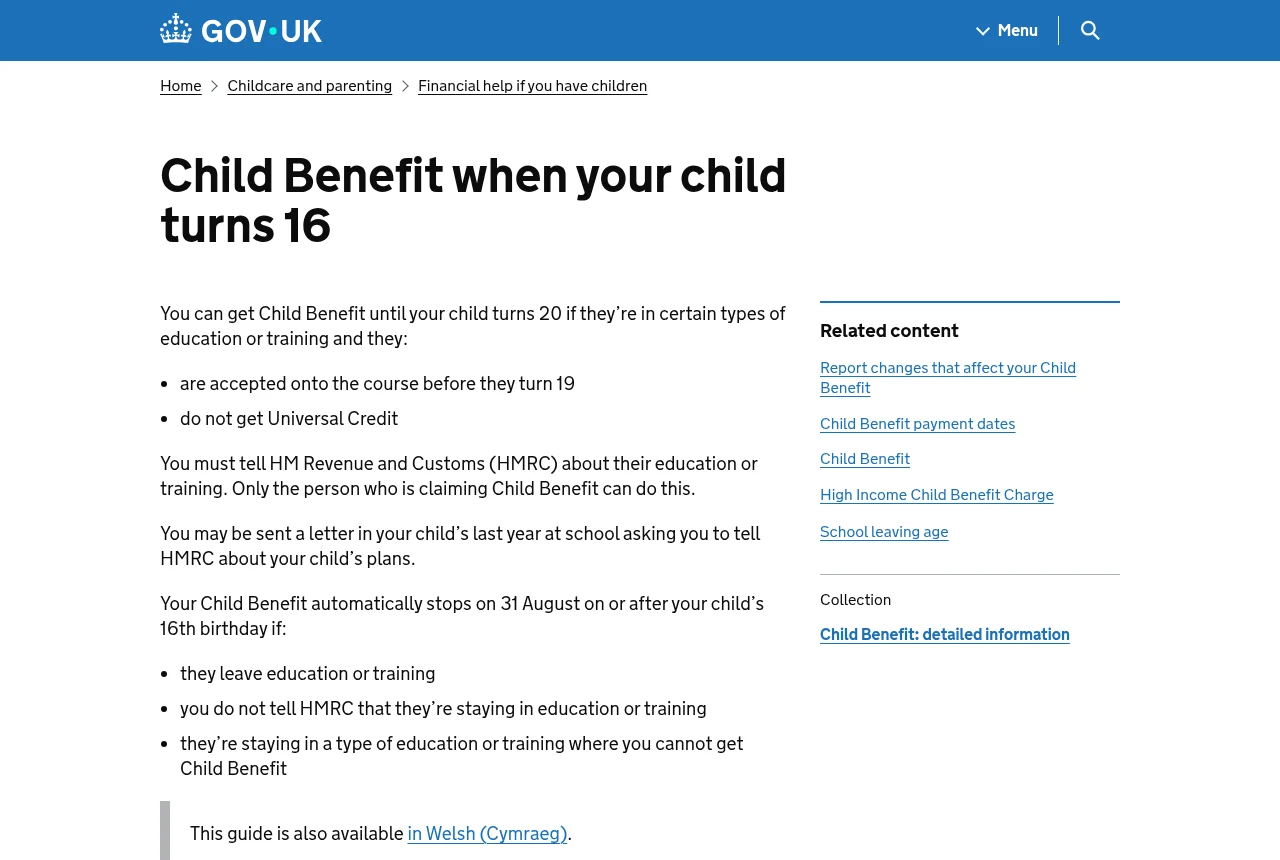
Child Benefit does not quietly carry on once your child turns 16. It stops on 31 August on or after that birthday unless you tell HMRC the young person is staying in approved education or training. Nothing arrives to warn you at the time; the payments simply stop.
Two things trip parents up every year. The first is the hours rule — a lot of people are working from the wrong number. The second is apprenticeships: parents assume an apprenticeship is exactly the kind of “staying on” the rules are meant to reward, and it is the opposite. Starting one ends Child Benefit.
Checkpoints
- The deadline is 31 August. It is the 31 August falling on or after the 16th birthday, so a child who turned 16 last autumn hits it this year.
- Full-time education means more than an average of 12 hours a week of supervised study or course-related work experience — meal breaks and unsupervised study do not count.
- An apprenticeship does not qualify. The only exception named in the regulations is a Foundation Apprenticeship in Wales, and only where the training is unpaid and not under a contract of employment.
- Only the person who claims Child Benefit can extend it — a partner cannot do it for you unless they are formally authorised.
1 Work out whether you need to act at all — and whether the course actually counts
You only need to do something if your teenager is starting a new course or qualifying training. If they are partway through a course you already told HMRC about, there is nothing to do. That single check saves a lot of parents an unnecessary phone call in August.
If it is a new course, test it against two rules. The hours rule: more than an average of 12 hours a week during term time, counting tuition, practical work, supervised study and exams. Time spent on meal breaks or unsupervised study is explicitly excluded. If your child has an illness or disability that makes 12 hours unrealistic, the rules now allow whatever number of hours is appropriate for their circumstances — that flexibility was written in from September 2025.
The level rule: the course has to be non-advanced. A-levels, T Levels, GCSEs, Scottish Highers, the International Baccalaureate, NVQs and most vocational qualifications up to level 3 all count, and so does home education. A degree, a BTEC Higher National Certificate, an HND, a CertHE or a pre-degree access course does not.
| Situation | Does Child Benefit continue? |
|---|---|
| A-levels, T Levels, Scottish Highers, IB at school or college | Yes — if more than 12 hours a week on average |
| Home education | Yes — the old restrictions on who could be home educated were removed in September 2025 |
| University degree, HND, HNC, CertHE, access to HE | No — this is advanced education |
| Apprenticeship | No — see the next section |
| A course paid for or arranged by an employer | No — training under a job contract is excluded |
2 The apprenticeship trap, and where the “20 hours” figure comes from
GOV.UK lists apprenticeships under training for which you cannot get Child Benefit, and separately confirms that payments stop when a child starts an apprenticeship in England. This catches families completely off guard, because every other part of the system treats an apprenticeship as a good outcome. For Child Benefit, it is the same as leaving education.
There is one exception written into the regulations: a Foundation Apprenticeship in Wales is named as approved training. Read the condition attached to it before celebrating — approved training must be unpaid and must not be provided under a contract of employment, and the standard apprenticeship route in Wales is normally an employed, paid one. Treat it as a question to put to HMRC rather than an assumption.
Now the hours. If you have seen 20 hours quoted, it is a real rule — just not this one. That figure comes from England’s participation duty, which says a 16-year-old must stay in education, start an apprenticeship, or spend 20 hours or more a week working or volunteering alongside part-time education. It governs what your teenager must do until 18. It has nothing to do with whether Child Benefit continues, which turns on the 12-hour test.
3 Extend it — and know what the separate 20-week “extension” is, because it is not this
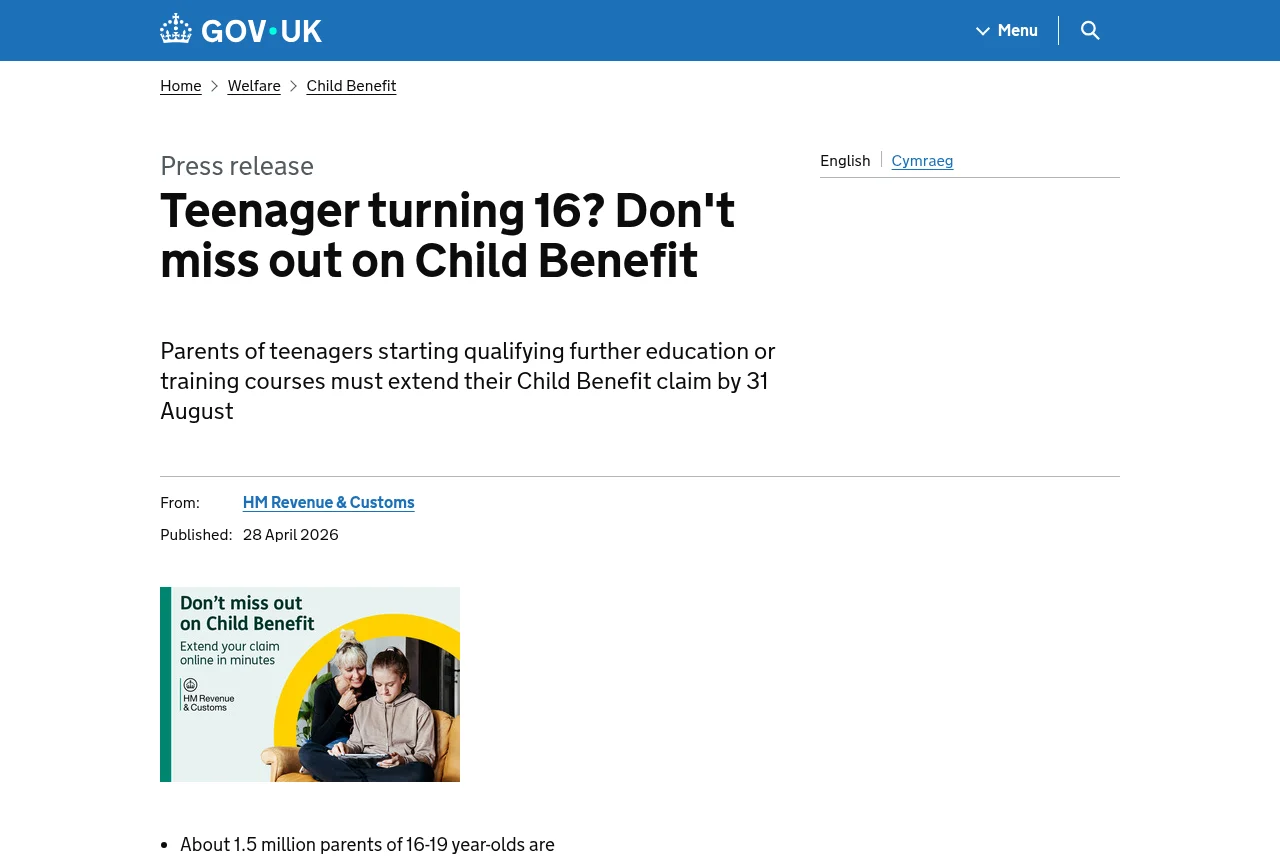
The digital route is fastest. The extension service has been open since 1 April, well before HMRC’s reminder letters go out, so there is no reason to wait for the post — around 1.5 million letters started arriving in May, each carrying a QR code. You can extend through the HMRC app or the online service; you will need your Government Gateway sign-in and your National Insurance number, and you can create the sign-in inside the service if you do not have one. If you would rather not go online, the Child Benefit helpline and a postal route both still exist.
If you miss 31 August, contact HMRC as soon as you know your teenager’s plans. Be aware that HMRC’s published position is only that payments stop — it does not promise to restore them back to 1 September for a late notification. The three-month backdating rule you may have read about applies to claims, which is a different thing. Treat the deadline as real rather than as a soft target.
One more thing worth separating out, because the shared word causes real confusion. There is a completely different 20-week extension period for a 16 or 17-year-old who has left education and registered with a careers service or signed up with the armed forces. That one needs its own form, has its own three-month application window, and requires the young person to be working less than 24 hours a week. It is not the thing you are doing here.
4 Common mistakes, and how to avoid them
Mistake 1
Using the 20-hour figure. Child Benefit needs more than an average of 12 hours a week. The 20 hours belongs to England’s participation duty — a different rule, on a different GOV.UK page, doing a different job.
Mistake 2
Assuming an apprenticeship keeps the money coming. It ends it. Only a Welsh Foundation Apprenticeship is named as approved training, and only where it is unpaid and not under a contract of employment.
Mistake 3
Waiting for the HMRC letter, then treating 31 August as negotiable. The service opened on 1 April, letters only started landing in May, and HMRC makes no published promise to restore missed payments if you notify late.
Do this today
If your teenager is starting a new course in September, extend the claim now rather than in the last week of August. It takes a few minutes in the HMRC app, and only you — the person named on the claim — can do it.
FAQ Frequently asked questions
My teenager is at college for 15 hours a week. Does that qualify?
Yes, on the hours test. Child Benefit needs more than an average of 12 hours a week during term time, counting tuition, practical work, supervised study and exams. Meal breaks and unsupervised study are excluded. Fewer hours can be acceptable if illness or disability makes 12 unrealistic for them.
My child is starting an apprenticeship in September. Will Child Benefit continue?
No. GOV.UK lists apprenticeships among the training for which you cannot get Child Benefit, and confirms separately that payments stop when a child starts an apprenticeship in England. A Foundation Apprenticeship in Wales is named in the regulations as approved training, but only where it is unpaid and not provided under a contract of employment — check with HMRC before assuming it applies.
What happens if I miss 31 August?
Payments stop automatically. Contact HMRC as soon as you can, but do not count on them being restored to 1 September — HMRC publishes no such guarantee. The three-month backdating rule that gets quoted online applies to new claims, not to a late education notification.
Key takeaways
- Child Benefit stops on the 31 August on or after your child’s 16th birthday unless you tell HMRC they are staying in approved education.
- The threshold is more than an average of 12 hours a week of supervised study. The 20-hour figure comes from a different rule entirely.
- Apprenticeships end the payments. The only named exception is an unpaid Welsh Foundation Apprenticeship outside a contract of employment.
- The online service opened on 1 April, only the named claimant can use it, and there is no published guarantee of backdating if you miss the deadline.