

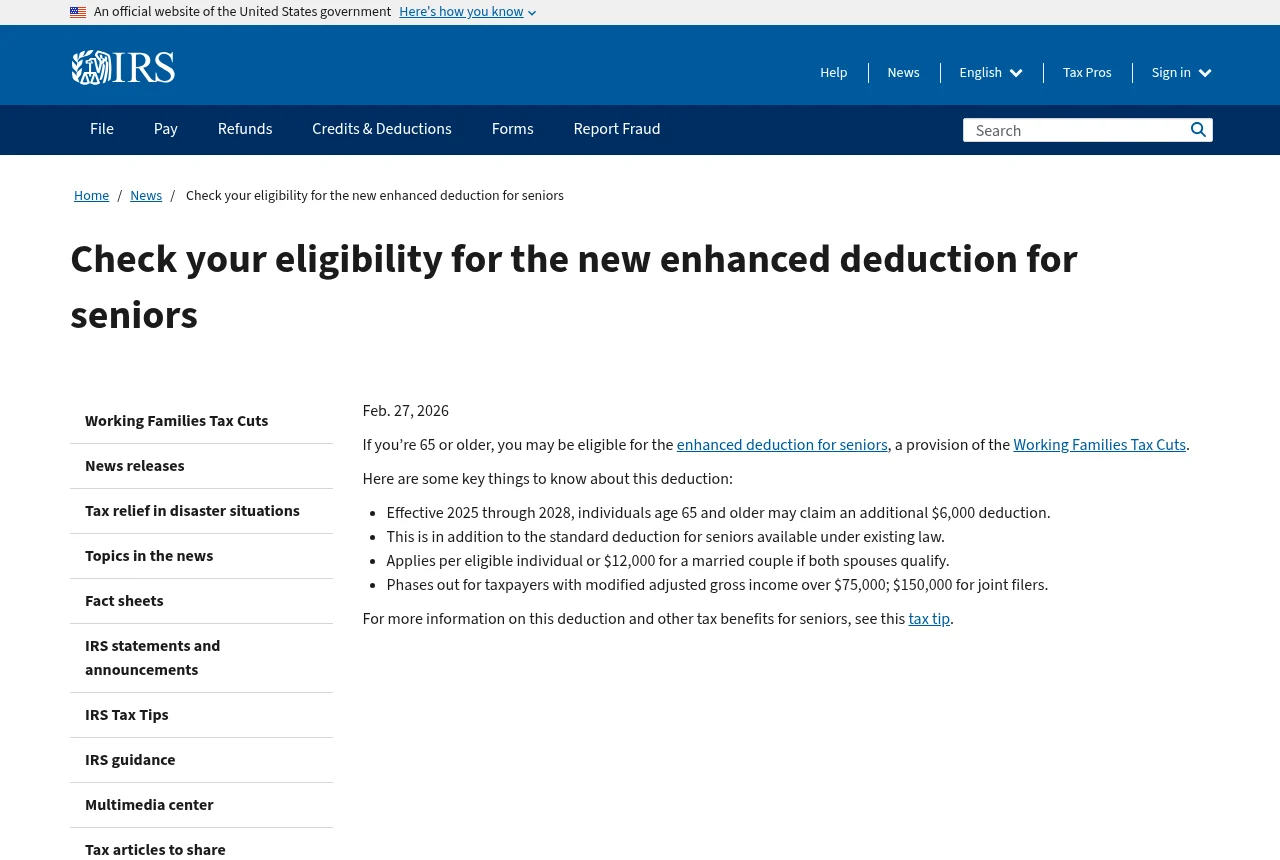
Since the One Big Beautiful Bill Act (OBBBA) passed, a lot of people over 65 have heard about a “$6,000 senior bonus” and pictured a check in the mail, or assumed it wipes out the tax on their Social Security. It does neither.
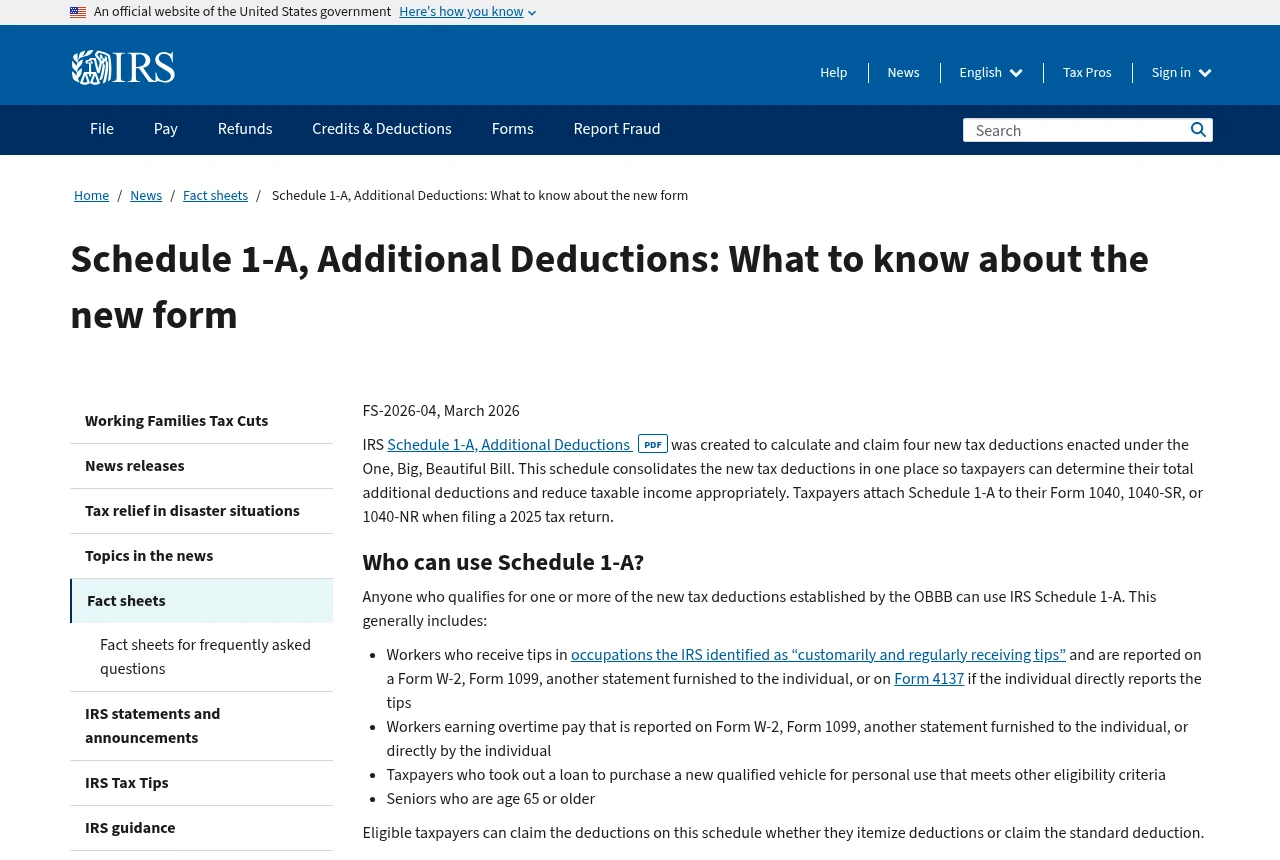
It is an extra deduction — it lowers your taxable income for tax years 2025 through 2028, and you claim it on a new form, Schedule 1-A. Here is who qualifies, how it stacks on top of the deductions you already get, and how to put it on your return.
Checkpoints
- It is a deduction, not a tax credit — it reduces taxable income, not your tax bill dollar-for-dollar.
- It stacks on top of your regular standard deduction and the existing age-65 extra deduction — it does not replace either.
- You can take it whether you itemize or use the standard deduction.
- It phases out above a modified AGI (MAGI) threshold and disappears well before high incomes — check the numbers below.
1 Check whether you qualify
The deduction is purely age-based, so you do not need to be collecting Social Security to claim it. Each spouse is tested on their own, and a married couple must file jointly to take it — Married Filing Separately does not qualify.
Run through the four tests below. If your MAGI is above the threshold, you do not lose it all at once; it shrinks gradually (see step 3).
| Requirement | Detail |
|---|---|
| Age | Turn 65 on or before the last day of the tax year |
| SSN | A valid, work-authorized Social Security number |
| Filing status | If married, you must file jointly (not MFS) |
| Income | Full amount up to MAGI of $75k (single) / $150k (joint) |
2 Understand that it stacks — it replaces nothing
This is the point most people get wrong. The new senior deduction is on top of your regular standard deduction, and it is also on top of the separate additional standard deduction you already get for being 65 or older. It is an extra layer, not a substitute.
Unlike that older age-65 addition (which only standard-deduction filers get), this new deduction is available to itemizers too. So whichever way you file, you can still claim it.
3 Claim it on Schedule 1-A
You figure the deduction in Part V of Schedule 1-A. Start at $6,000 per qualifying person ($12,000 if both spouses are 65+ and filing jointly), then reduce it by 6% of every dollar of MAGI above your threshold. It reaches zero at roughly $175k (single) / $250k (joint). Part VI totals it up, and the total goes on Form 1040 (or 1040-SR), line 13b. Attach Schedule 1-A to your return.
It first applies to tax year 2025 — the return you file in 2026 — and is scheduled to run through tax year 2028.
4 Common mistakes, and how to avoid them
Mistake 1
Treating it as a credit. It is a deduction — it lowers taxable income, so its value depends on your bracket. It cannot by itself create or enlarge a refund, and any unused portion is simply lost.
Mistake 2
Thinking it replaces the standard deduction. It does not. It sits on top of the standard deduction and on top of the existing age-65 extra deduction.
Mistake 3
Assuming a married couple automatically gets $12,000. That only happens when both spouses are 65+. If just one is, it is $6,000.
Mistake 4
Ignoring the phase-out. Above the MAGI threshold it drops 6% per dollar — it is not all-or-nothing, and it is gone entirely at higher incomes.
Mistake 5
Believing it “eliminates tax on Social Security.” It does not change how your Social Security benefits are taxed; it is a separate age-based deduction.
Do this today
Before you file, confirm your age, SSN and MAGI against the current IRS eligibility page, and make sure your preparer or software is using Schedule 1-A.
FAQ Frequently asked questions
I don’t collect Social Security yet. Can I still claim it?
Yes. The deduction is based on age (65+) and a valid, work-authorized SSN. You do not need to be receiving Social Security benefits to qualify.
Does it lower the tax on my Social Security benefits?
Not directly. It does not change how much of your Social Security is taxable. It is an age-based deduction applied to your overall taxable income, so it can reduce your total tax, but it is not a Social Security tax cut.
Do I have to itemize to get it?
No. You can claim it whether you take the standard deduction or itemize — either way you report it on Schedule 1-A.
Key takeaways
- The OBBBA senior deduction is an extra deduction of up to $6,000 per person 65+, for tax years 2025 through 2028.
- It is not a check and not a credit, and it does not replace your standard deduction — it stacks on top of it.
- You claim it on Schedule 1-A (Part V), whether you itemize or not; it phases out above the MAGI threshold.
- Confirm the current-year figures and form on IRS.gov before filing.