
A new law lets many drivers deduct the interest on a car loan for tax years 2025 through 2028 — up to $10,000 a year. It sounds simple, but most of the people searching for it will not qualify, because the rules turn on details of the vehicle and the loan, not on whether you bought a car.
This is a deduction, not a rebate check. It lowers the income you’re taxed on, so its real value is roughly the amount you deduct multiplied by your tax rate — not a payment that lands in your account. Knowing whether you qualify is worth doing before you buy, not at filing time when it’s too late to change anything.
Checkpoints
- It’s a deduction you can take even if you use the standard deduction — you don’t have to itemize.
- Only a NEW vehicle with final assembly in the United States qualifies; used cars and leases do not.
- The loan must be originated after 31 December 2024 and secured by a first lien on the vehicle.
- The benefit phases out at higher incomes and the $10,000 cap is per return — it is not doubled for a married couple.
1 Before you buy, confirm the vehicle actually qualifies
Four things about the vehicle decide it: it must be new (its first use begins with you), it must be a car, minivan, van, SUV, pickup, or motorcycle under 14,000 lb, it must be for personal use, and its final assembly must be in the United States. A well-known domestic brand can be built abroad, and an import brand can be built here, so the badge tells you nothing.
Check assembly two ways: the window sticker on the car lists the final-assembly plant, and the NHTSA VIN Decoder shows the plant country when you enter the 17-digit VIN. Note the two traps people get backwards — motorcycles do qualify, but RVs, motorhomes and travel trailers do not.
2 Finance it the right way, and check your income
The interest only counts if the loan was originated after 31 December 2024 and is secured by a first lien on the car. Paying cash, leasing, or using an unsecured loan or a home-equity line means there’s no qualifying car loan interest to deduct, no matter how new the vehicle is.
Then check your income. You get the full benefit below $100,000 (single) or $200,000 (married filing jointly); it shrinks above that and disappears entirely at $150,000 / $250,000. One catch worth knowing: taking this deduction does not lower the income figure used for that phaseout, so it can’t pull you back under the line.
| Your income (MAGI) | What you get |
|---|---|
| Under $100k single / $200k joint | Full deduction, up to the cap |
| Between the thresholds | Partial — it phases down |
| Over $150k single / $250k joint | Nothing from this deduction |
| Married filing jointly | One $10k cap for the return, not two |
3 Claim it on your return — even with the standard deduction
This is claimed on the new Schedule 1-A (Form 1040), in the car loan interest section, and you enter the vehicle’s VIN there. It works whether you take the standard deduction or itemize, which is the part people most often miss.
Because it reduces taxable income rather than paying you directly, don’t expect a separate check. Its worth depends on your tax bracket. Keep your purchase documents, the VIN, and the lender’s interest statement with your tax records in case you need to show them.
4 Common mistakes, and how to avoid them
Mistake 1
Assuming a used car or a lease qualifies — only a new, purchased vehicle does.
Mistake 2
Treating it as a rebate check; it’s a deduction worth roughly your tax rate times the amount.
Mistake 3
Not realising it works alongside the standard deduction, so you skip it thinking you must itemize.
Mistake 4
Ignoring the US-final-assembly rule, or mixing up that motorcycles qualify while RVs do not.
Mistake 5
Being caught out by the income phaseout, or assuming a married couple gets two $10,000 caps.
Do this today
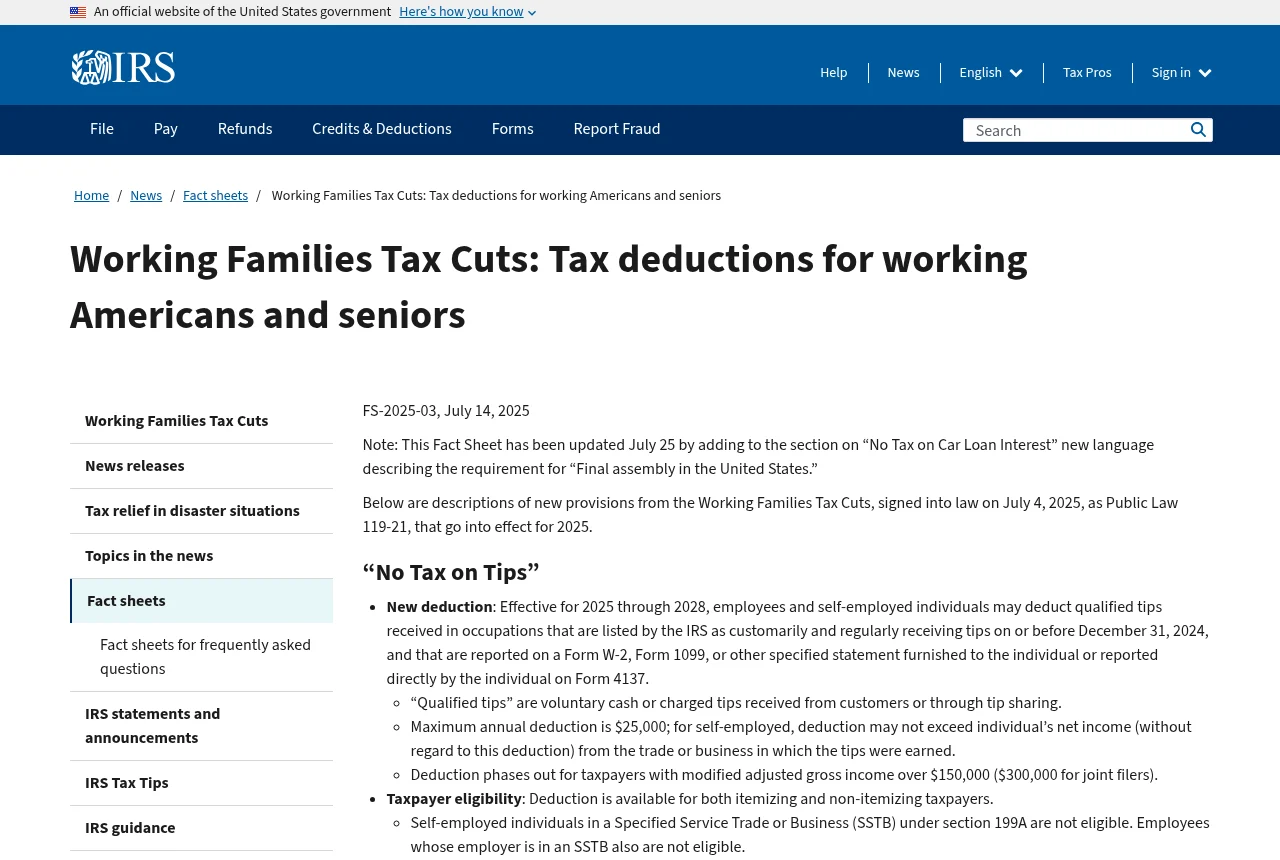
Check the vehicle, loan and income rules on the official IRS page before you buy or file.
FAQ Frequently asked questions
Do used or leased vehicles count?
No. Only a new vehicle whose first use begins with you qualifies, and it must be purchased on a qualifying loan — lease payments are excluded.
Do I have to itemize to claim it?
No. It’s claimed on Schedule 1-A and is available whether you take the standard deduction or itemize.
How do I know my car was assembled in the US?
Check the final-assembly line on the window sticker, or enter the VIN in the NHTSA VIN Decoder and confirm the plant country is the United States.
Key takeaways
- A new deduction covers up to $10,000 of car loan interest for tax years 2025-2028.
- Only a new, US-assembled vehicle for personal use, on a loan originated after 31 Dec 2024 and secured by a first lien, qualifies.
- It’s a deduction, not a check, and it works with the standard deduction.
- The benefit phases out above $100k/$200k and the cap isn’t doubled for couples — verify current figures on IRS.gov.